Saturday, September 11, 2021

Bear River Migratory Bird Refuge and A Lunar Landscape

 Friday, September 10th found us greeting the dawn the Bear River Migratory Bird Refuge west of Brigham City, the self proclaimed migratory bird capital of America.

Clouds hung over the Wasach range, occasionally sprinkling the land with much needed water but clearly these little showers did nothing to raise even a puddle on the parched and cracked playa dotted with sage. 

After 12 miles of hard surface road into the refuge and the dusty gravel auto loop, we began seeing birds.Lots of birds. American White Pelican and a lone Ring-billed Gull sat at the entrance to the auto loop. House Sparrows crowded on the side of the road flying away when we drove by.

the canal along this portion of the loop yielded Great Blue Heron and a pair of Ring-necked Pheasant scurry from cover on one side of the road to the other. In sedge and mud we paused to see life birds for us: two Sandhill Cranes giving us a great show with croaking and leaping into the air.


I exited the truck to hide behind the hood to take these photos while Dan stayed in the cab using the window ledge as a tripod. I was immediately besieged by hundreds of mosquitoes and midges. They even followed me into the truck and flew in through Dan's open window. We then played a game of squish the insects and wisely brought out the insect spray, putting it on paper towels and rubbing it all over. That did the trick. Although the inserts still flew in every time we opened the truck doors or windows. 

A large pond in the center of the auto loop road gave us hundreds of American Coot and, another lifer for us, Western Grebe.

As we drive along a flock of about 40 large blackbirds clustered on the road ahead of us. We stopped and saw that these these birds were Yellow-headed Blackbirds, another lifer. There were hundreds of the much more familiar Red-winged Blackbirds all around us in the tall grass plumes on either side of the road. But even from a distance these blackbirds were larger. They flew off as we drive near so a photo was impossible. We were so thrilled to see them.

In addition to the vast numbers of Red-winged Blackbirds, Barn and Tree Swallows by the hundreds swooped and dove through the insect swarms illuminated in the late morning sun. Some perched ona small bridge railing giving us better views. We learned that the cave swallows that build theur mud nests under the overhang at the visitors center were gone. 


On the mud flats, we observed American Avocet, Kildeer, Black-Necked Stilt, Lesser Yellowlegs, Snowy Egret, and a lone American White Pelican.


The stilt was another lifer. As was the Vesper Sparrow that paused long enough on the verge of the road for us to get a great look and a quick photo.

Bear River MBR was incredible and so amazingly different from anywhere we had birded on the east coast unless...you count Craters of the Moon National Monument, our next stop several hours away.

Two more lifers greeted us in that landscape that at first glance looks incapable of supporting life, but is actually a fabulous ecosystem. There we saw a Clark's Nutcracker eating a pine nut on a snag.

And a female Moutain Bluebird was simply perched on our way out of the park. 

 A wonderful birding day from end to end.


Thursday, September 9, 2021

Eastern Idaho

 We traveled into eastern Idaho on route 34 through the Caribou National Forest and into the eastern side of Gray's Lake NWR. Incredible scenery at every turn as well as raptors. We saw lots of Red-tailed Hawks perched on telephone poles, fence posts, and snags.

American Kestrels dotted wires along the road side.

The day's surprise was at the entrance to Tin Cup Trail in Caribou NF. As hundreds of sheep bleated on the nearby hillside we observed from about 20 yards away at the trailhead a Great Gray Owl. 


We never thought we would see one of these large owls, but there it was. One of the best birding days for raptors we have ever had.


Yellowstone National Park


Yellowstone National Park is one of those iconic American parks, in fact it’s the oldest national park in America. We drive to the east entrance from Cody arriving before 8 in the morning. On the way to the entrance we spied several Black-tailed Magpies along the road through the gorgeous canyon. Unfortunately we saw a couple of road kill magpies too. A large black bear nearly became road kill when it missed being hit by an RV head of us by a toe before leaping back the way it came.


Once in the park driving west we saw a Red-tailed Hawk perched on snag on the side of the road. Several Big Horn sheep grazed lazily by the guardrail, giving us snort when we paused to observe them closer.  it became very evident that this section of park was recovering from wildfires of years past. The skeletal blacked and sun bleached fir trunks pierced the sky on either side of the road. The air had the haze from the large wildfires to the west in northern California.


But life springs eternal in Yellowstone and grasses and young fir flourished among the charred remains of the larger victims of the fires. It was in these grasses that we spied a mother grizzly bear with her large cub pawing at the roots of the plants growing around the dead fall. They deftly maneuvered the sticks and logs in search of breakfast. The bears were many yards away from us and the dozens of other observers on the overlook.


Along the north end of Yellowstone Lake we stopped to observe a raft of about a dozen Common Goldeneye and Ravens croaked from the trees nearby. Farther along near the river in a grassy verge a Northern Harrier scudded over the grassy wetland, its white rump patch clearly visible.


We took a turn north past the fishing village area and headed to the area called Mud Volcano where the ranger said we might find a few Trumpeter Swans. We did and just as promised we found two, or possibly a pair, in the shallow Yellowstone River. One rested on the grassy bank while the other swam and scraped the mud with is webbed feet before sticking it’s face underwater to get the treats it stirred up. Its white head feathers and part of its neck were stained brown from the muck. Canada Geese and female Mallard also joined the swans dabbling in the muck.


We traveled to Yellowstone Canyon and to the Artist’s Point observation area. The deep canyon and waterfall are spectacular. Perched on a tree way on the opposite canyon wall was an Osprey which we heard before finding.


Just south of the Mud Volcano we ventured into an open field bordered by deadfall and live firs to view the smoking landscape on the other side of the river. There a Red-tailed Hawk perched on a snag before swooping down into the grassy riverbank to grab some small prey. After a few minutes it emerged from the grass to rest on a log. 


 A Clark’s Nutcracker in the vicinity gave several angry raspy calls before flying to the other side of the river to perch on a pile of logs. Its call reminded us of that of a Belted Kingfisher.


We learned that in the vastness of Yellowstone finding birds is by luck. There is not one really great hot spot. The whole park is a hot spot of you are patient enough to look and listen. It’s a place we would like to explore far more, perhaps in another season and when the haze from distant wildfires obscure the landscape.

Tuesday, September 7, 2021

Spearfish Canyon SD and Devil's Tower WY

On this crisp morning, we headed to Spearfish Canyon as the sunlight was touching the top of the canyon walls. Our search was for the American Dipper. A common bird out west but not seen anywhere near our east coast home. We were excited at the prospect of seeing this bird in action. We began the day at Roughlock Falls down a dirt road to a nook on the canyon with the Little Spearfish River meandering though to tumble down the falls and continue onward. The first bird we saw was an American Redstart skulking by the stream and a Swainson's Thrush hunting insects from nearby brush.

We headed north through the canyon with its towering pine covered yellow walls and Spearfish Creek cutting through it. We stopped at the Bridal Veil Falls overlook high above the creek and peered down. Dan spotted the American Dipper on a log in the water preening itself. We watched this remarkable little bird, post preening, dip its head into the moving water, bob up and down on rock and log, and float with the gentle current to its next watery perch. 


We departed the canyon and headed to our next stop after a brief stop at the DC Booth National Fish Hatchery. Never seen so many trout in my life!

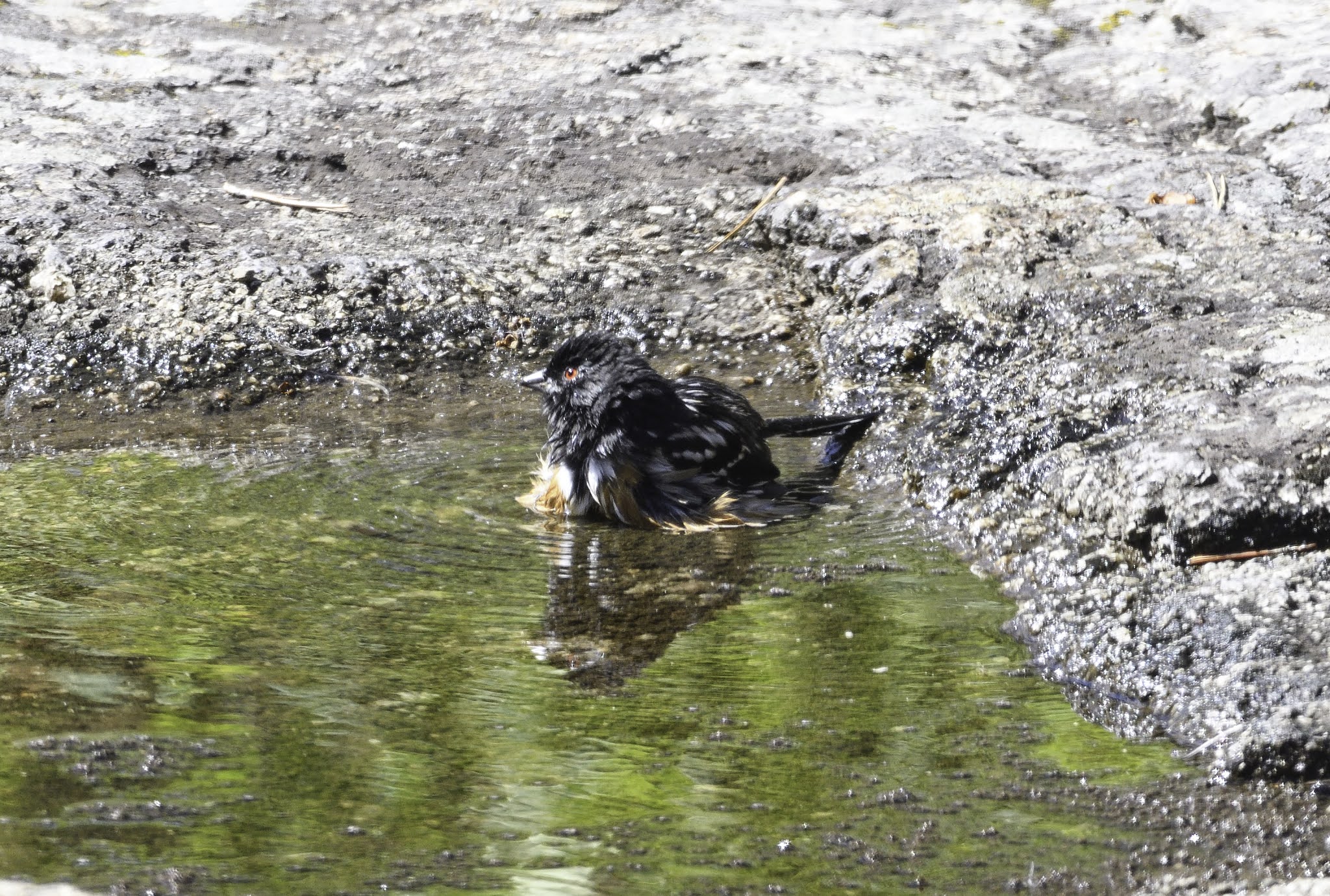
On into Wyoming and Devil's Tower National Monument. A puddle in one of the boulders at the base of the monolith attracted male and female Red Crossbills and a Spotted Towhee.


The pine woods near the parking lots had chattering Black Capped-Chickadee and white Breasted Nuthatch. 


The day was a great success as we finally got to see the wonderful American Dipper and a lot of equally fabulous birds in a variety of spectacular western landscapes


Monday, September 6, 2021

Badlands National Park

 Badlands National Park is one of those environments that calls forth so many different adjectives:  stark, barren, beautiful, amazing...I agree with all of those except for barren. There is so much life in the Badlands. The life we, of course, are interested in seeing are the feathered kind. And we realized that you had to look and look hard to find them among the crevices, the sagebrush, the grasses, the wildflowers, often so very far away and sometimes up close.

The first bird we saw was of the familiar eastern variety: Eastern Bluebird at the eastern visitor center.

We asked at the visitor center where we could find the birds, and were directed to a side road called Conata that exited the Badlands NP, turned gravel, and bordered the Buffalo Gap National Grasslands and private property surrounded by a wire fence. It was a remote and quiet place away from the more popular loop road.


This remote place did not disappoint. We saw Western Meadowlark singing on the fence.


Clay-colored Sparrows flying up from the roadside to perch on any fence or wire, the tallest things close by.

The best bird we saw was a Burrowing Owl at a prairie dog town just inside the fence of the private property. It was a bird we had hoped to find on this journey and were delighted that we did. The bird flew back and forth between burrowing mounds, catching insects. It gave us a distant but great show! 

Back on the popular loop road, we stopped at an overlook and peered down the canyon of striated mounds dotted with sage and other small plants. We were delighted to see Rock Wren.


We took away memories of great birds we had never seen before and a couple of familiar favorites, and a dozen or so burrs on our shoes and pant legs.


Sunday, September 5, 2021

Kiowa Waterfowl Production Area, Iowa

 Crossing the prairies and cornfield of central Iowa making our way farther west to where the western birds are, we took a small detour from Route 20 to the Kiowa Waterfowl Production Area. It was 10:45 when we rolled up to this marshy wetland in between grassy farmlands.


There were not a lot of birds. We saw Wood Duck, Barn Swallow, a female Mallard, and American Goldfinch. The most exciting sight was about 80 American White Pelicans flying over heading southward.


It was great fun birding a habitat so different from the habitats back home in northern Virginia. Seeing the pelicans made our day!


Friday, September 3, 2021

Hebron, Ohio State Fish Hatchery

 Day one of our month long cross country road trip found us taking a lovely detour from I-70 to the Hebron, Ohio State Fish Hatchery. 

 We arrived mid-afternoon and the sun was bright and the air not too humid. We explored some of the trails around the ponds where the fishes are kept at different life stages. 

 Paddle wheel aerators positioned at the edges of the ponds attracted Double-crested Cormorant, Great Blue Heron, and a lone Great Egret who showed us what adept fisherman he was. This seemed to be to the chagrin of two Belted Kingfishers who strafed the ponds chattering nosily. The Great Egret would not be deterred. We watched him within the span of five minuted deftly remove three small fish from the pond's edge.


Other birds we saw were two Bald Eagles lazily circling above the drained fish ponds, a noisy Kildeer in one of the drained ponds, Cedar Waxwing,  Eastern Phoebe, American Goldfich, and 40 Canada Geese including a half-dozen goslings by and in one of the full ponds. We saw quite a lot of insects and photographed a few but our identification skills are pretty much nil. Even though we don't know their names, we were happy to observe them on this beautiful day.